Proceed [v. pruh-seed; n.
proh-seed] To move on or go forward or onward, especially after stopping.
a Steve Wagner memoir | summer 2015
I can vividly recall being a fifth grader in the mid-1990s, watching
out the front window of my living room as neighborhood kids raced up
the street on their beat-up Honda dirtbikes. The noisy and
haggard-looking machines caught my attention, and I fantasized about
one day just owning a motorcycle, let alone the idea of ever
getting good at riding them. Acquiring a bike was not going to happen
very easily, so in the meantime I would look through motocross
magazines and watch the occasional race on CBS Sports Sunday morning
television to appease my curiosity. Riding motorcycles is an
expensive hobby, and despite my lack of finances I was pretty
committed to getting one. I would spend the next decade of my life
dedicated to riding motorcycles, and after my professional career
ended prematurely, ten years and a major brain injury later I can
still remember that chapter in my life quite well.
1995-1997
To satisfy my desire to own some sort of motorized, two-wheeled
machine, my middle school years were spent doing whatever I could to
earn money so that I could buy and fix up old dirt bikes. The summer
before 6th grade, I purchased a home-built mini-bike frame with $50
of lawn-mowing cash and outfitted it with an old snow blower engine
that was collecting dust in my family's garage. I worked tirelessly
to get that thing running; I replaced the ignition points, cleaned
the valves, and turned every screw on the carburetor until it ran right.
I would go through
several old
motorcycles
over the next two years, and I spent more time working on those
things than riding them. I gained an appreciation for troubleshooting
and repairing motorized equipment during those years, and it wouldn't be
until I turned 14 in November of 1997 that I would be able to afford
a decent bike. It was then that I got a part time job at McDonalds,
and that would allow me to eventually save up for something newer.
1998 - 2001
After saving up for several months, I was able to purchase a Kawasaki KX125
that was only a few years old, and it was then that I would start
trying to ride motocross. After
spending all my savings on a bike I couldn't afford legit
gear or even a real stand, but I made due wearing old
coveralls and using a 5-gallon bucket to support my bike. The stares
at the local Motocross track didn't deter me; the action-sports craze
of the latter 90s adequately fueled my excitement, and almost
immediately I started jumping jumps and teaching myself the Freestyle
tricks I saw in videos.
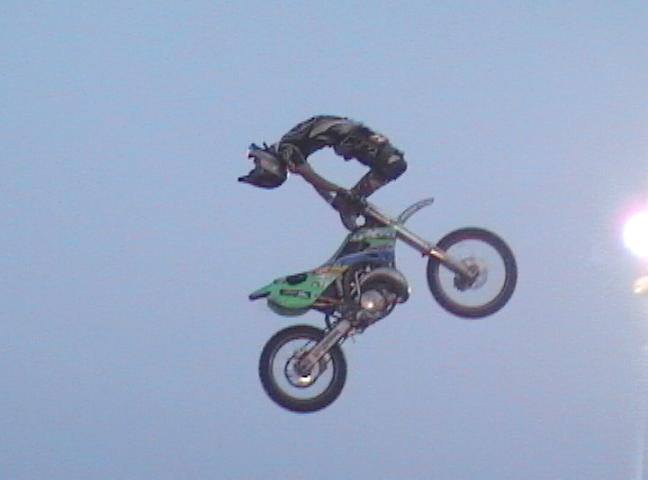 By
the time I was a junior in high school I had a decent repertoire
of moves including Supermen, Cordovas
, and No Handed Landings. Though my few tricks did turn heads
occasionally, I was not a spectacular or experienced rider. My lack of a good place
to practice was possibly a setback and I always felt like I was a step behind
my peers when it came to my opportunities to improve. Regardless, I
did what I could just to be involved in the Freestyle Motocross (FMX)
scene no matter what. I rode as often as I could despite not having
many friends that shared my interest. I participated in jump-offs
at local motocross races, fairs, and monster truck shows with
adequate results, but I was not entirely satisfied with my
performances. However, I was having so much fun just riding
and it never crossed my mind that I may one day have the skills to do
it for a living.
By
the time I was a junior in high school I had a decent repertoire
of moves including Supermen, Cordovas
, and No Handed Landings. Though my few tricks did turn heads
occasionally, I was not a spectacular or experienced rider. My lack of a good place
to practice was possibly a setback and I always felt like I was a step behind
my peers when it came to my opportunities to improve. Regardless, I
did what I could just to be involved in the Freestyle Motocross (FMX)
scene no matter what. I rode as often as I could despite not having
many friends that shared my interest. I participated in jump-offs
at local motocross races, fairs, and monster truck shows with
adequate results, but I was not entirely satisfied with my
performances. However, I was having so much fun just riding
and it never crossed my mind that I may one day have the skills to do
it for a living.
The fall of my senior year in high school I had an idea. I figured
that the steel takeoff ramps all the professionals were using may be
the key to improving my trick list, and I badly wanted one. Up until
that point I had been practicing on whatever dirt jumps that I could
carve out of the hills near my house, and I was never capable of
building a jump that provided me with the right amount of airtime or
flight path to adequately attempt FMX tricks.
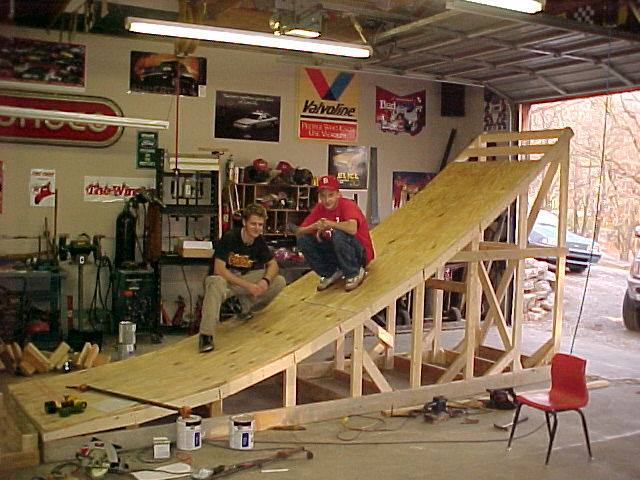 Because I lacked the tools and expertise to fabricate anything out of
metal, that October I would spend my free time designing and building
a professional-style FMX ramp out of 2x4s and plywood. I was the
first in the sport to do that successfully and later built a website
that made the plans available. I also significantly upgraded my practice
area in the large, abandoned lot near my house, and it was that
winter that I started to really improve. I rode almost every day. I
set goals. I had my friends
video
tape
me so that I could measure
and track my progress, and I continued to look for events to
participate in.
Because I lacked the tools and expertise to fabricate anything out of
metal, that October I would spend my free time designing and building
a professional-style FMX ramp out of 2x4s and plywood. I was the
first in the sport to do that successfully and later built a website
that made the plans available. I also significantly upgraded my practice
area in the large, abandoned lot near my house, and it was that
winter that I started to really improve. I rode almost every day. I
set goals. I had my friends
video
tape
me so that I could measure
and track my progress, and I continued to look for events to
participate in.
2002
I had already made a few bucks riding in those small events but that
February is when I did what I consider my first professional show at
Kemper Arena in KC. I saw advertisements for a Monster Jam being put on there by Clear Channel
Motorsports, and when I saw there would be an FMX feature in the
show I searched online and called everyone I could to weasel my way
into the event. I eventually spoke with a man who was their rider
representative, and I asked him what it would take to let me ride.
After much nagging he agreed to allow me a spot in the show with no
promise of being paid, and of course that did not matter to me. I was
just excited to participate in an event with other professional
riders. During a weekend in February, I rode
well in all four shows and impressed the other riders as well as
the event staff. News of my good performance got back to Clear
Channel, and ultimately I was paid 500 bucks. It was at that point I
thought to myself, "I have a shot at this." 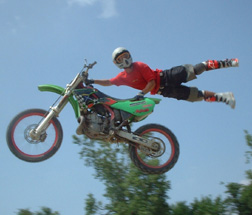
That spring and summer I kept riding, kept progressing, and kept my
sights set on riding in more professional events. I networked online
to make friends with other riders, and got seriously interested in
making motocross videos. In June I traveled to Oklahoma to ride with
a couple of FMX up-and-comers and a top professional, Kenny Bartram.
I rode well and made the six-hour drive home feeling confident with
my progress. At that point I was eager to test my progress and
compare my skills against other riders so that July I went to an
event a few hours away in northeastern Missouri. A county fair was
having a motocross race and they were hosting a halftime jump
contest. I would probably be the most dedicated FMX rider there with
the best bag of tricks, so I figured that I had a pretty good chance
of earning the modest purse of $250. I had some success during
practice, and people watched as I was the only rider throwing out big
tricks such as the "Superman seat grab" and "Indian
air." However, my day was about take a turn for the worst.
As time was winding down in practice I went to hit the jump that I
had been riding the entire afternoon. I wanted a few more runs on the
big finish line where we would be doing our FMX contest. I made a
rookie mistake and accidently hit a bad line on the takeoff, and I
wasn't prepared for how the jump would throw me. Because I had
committed to my trick and was already starting to come off the bike
as it left the ground, once I realized my mistake it was too late. As
I popped off the bike for my trick, it looped out from underneath me.
I went the entire 85 feet through the air with no motorcycle beneath
me and landed upright and hard on both legs, coming to a stop on my
back in a cloud of dust. Both legs were in severe pain, and when I
looked over at my left leg it was turned away from my body a full 90
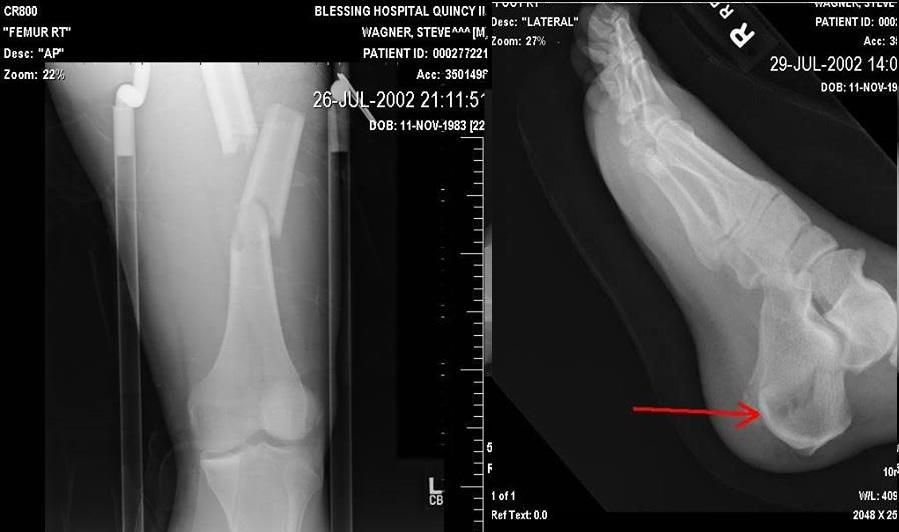
degrees. I had snapped my femur clean in two places, and shattered
the heel of my right foot. After a 45 minute ambulance ride, one
surgery with another scheduled, and a painful five day hospital stay,
I made it home only to wonder if I would continue to progress.
Recovery was boring. With two broken legs I was bedridden, and I
tried to find things to do. Since I had just graduated high school,
my family insisted that I at least enroll in community
college. While I went through the motions to satisfy them, all I
could think about was my involvement in FMX and getting back on the
bike. I spent lots of time on the computer, browsing internet FMX
forums, watching Motocross videos, and editing riding footage for the
motocross video I had started working on prior to my crash. In
October I started walking again as I ignored my online coursework and
continued shooting new footage for the video. Titled REPRESENT,
it would be the first of five motocross DVDs that I would produce (or
help to produce) over the next few years. Production included several
film trips to Oklahoma that fall where I would shoot video with the
riders that I had met that previous summer.
During the recovery I had trouble focusing on anything other than
dirt bikes; I was only concerned with my growing involvement in the
still very young sport of Freestyle Motocross. I drove to St. Louis
to watch the Vans Triple Crown of FMX and finished production on REPRESENT,
informally premiering it
at an after party for the Kansas City stop of the IFMA (International
Freestyle Motocross Association) tour. That led to me being
approached and asked to co-produce the sport bike/FMX video, A Few
Loose Screws. I also continued to network my way into the close
circle of promoters, managers, and riders in an effort to stay
occupied doing anything related to FMX. Even though I was not
currently riding, my life was all about dirt bikes.
Late in November I heard from the Clear Channel rep again, who I had
not spoken to since the previous February. He needed a rider and
asked if I would be willing to participate in several events on the
winter Monster Jam tour. It was what I had done at Kemper Arena
earlier that year, and I knew this was an opportunity that I should
take advantage of. I had not been on the bike since my accident in
July, but I kept that to myself and agreed to the dates he offered
me. After riding only a couple times that December, my first event
would be Des Moines, Iowa in early January. Fearing that my father
wouldn't condone my riding in an FMX show while still healing from
two broken legs, I didn't tell anyone I was leaving. After making the
short trip up I-35, I rode well
all weekend and made several new friends. To my surprise,
my dad was not upset when I told him where I had been. He also didn't
seem to mind that I would be on tour and traveling to events across
the country for the next several months. Maybe he was just happy to
have his snotty, 19 year old on the road and out of the house.
Whatever his reasons, his support allowed me to pursue a career in
FMX. I rode well that winter and was able to begin a career of riding
that would last for three years. I would inevitably ride in about
thirty events annually, one almost every weekend during the winter
and summer months, with a few dates in the spring and fall.
2003 - 2005 >